China’s AI Industry Enters Critical Transformation Amid Booming Token Economy
The era of Token economy – where Token serves as a digital identifier in the computer field – has arrived in China, with the country’s daily Token consumption surging to 180 trillion. A new model emerges every 1.5 days on average, driving explosive growth in connectivity and computing and unlocking enormous development opportunities. These dynamic figures reflect that China’s artificial intelligence (AI) industry is standing at a critical juncture, transitioning from quantitative to qualitative change.
As intelligent upgrading across industries accelerates, the market demand for deterministic networks, data center interconnection and industrial supercomputing is set to surge. It is estimated that this will bring more than 800 billion yuan of market opportunities to the Information and Communications Technology (ICT) industry in 2026. ICT, a comprehensive term covering all communication equipment, application software and related services, has become the backbone of the AI industry’s development.
Faced with this trillion-yuan blue ocean, enterprises in the AI industrial chain are accelerating their transformation from mere hardware suppliers to full-stack ecosystem builders. A fierce industrial race focusing on computing power infrastructure, ecosystem construction and commercial implementation has already begun.
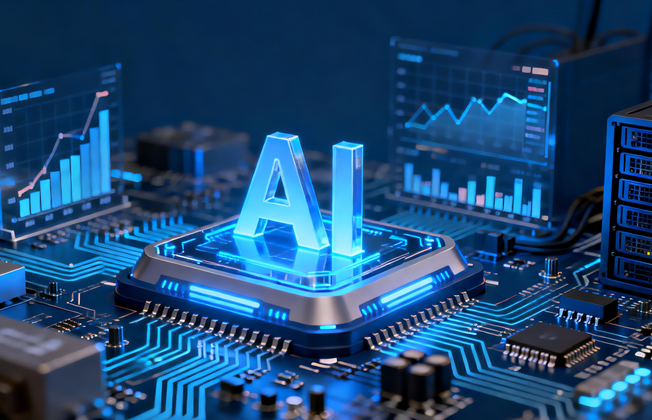
With the rapid iteration of large model technology, the AI industry is crossing a critical threshold from a technology explosion period to an application explosion period. The large-scale development of the AI industry relies on the carrying capacity of infrastructure, and the in-depth coordination of computing power, networks and data has become the core factor determining the industry’s growth rate.
Intelligentization has rapidly moved from the "visible" stage to the "usable" stage, evolving from general-purpose models to broader industry applications. AI agents and industrial intelligence are no longer distant visions, but are accelerating their integration into all walks of life like water and electricity. This shift has directly driven an exponential increase in demand for underlying infrastructure.
The large-scale implementation of AI agents has accelerated application innovation and promoted exponential growth in Token consumption. Meanwhile, the widespread deployment of intelligent industrial applications has triggered an overall explosion in demand for computing power of various specifications, making computing power infrastructure the primary investment direction for enterprises. Additionally, AI will be ubiquitous, and AI without networks is an information island; it is expected that the interconnection of massive intelligent agents in the future will bring a "100-fold growth in a decade" to network traffic demand.
This explosive demand growth has created huge market space for ICT infrastructure enterprises upstream of the industrial chain. For these enterprises, the key to seizing the spilled dividends lies in their ability to provide high-quality infrastructure adapted to the Token economy. Intelligentization has evolved from "general-purpose models" to broader "industry application agents", and the collaborative capability of multi-agents has matured, driving AI from an "auxiliary tool" to a "core production" link in enterprises.
As AI penetrates more fields, individual efforts by industrial chain enterprises can no longer meet the fragmented needs of various industries. Building an open and win-win ecosystem has become the consensus of enterprises in the middle and lower reaches of the industrial chain.
Huawei Technologies Co., Ltd. (Huawei) adheres to fully embracing AI, building a solid computing power base, promoting open-source and open cooperation, reconstructing products and solutions with AI technology, and supporting partners to enable full intelligentization of all industries. Leveraging its multi-industry collaborative advantages in connectivity, computing and cloud, Huawei transforms its years of technological accumulation into the commercial competitiveness of its partners, and strengthens the "partner + Huawei" cooperation system to enable partners to grow continuously based on its platform.
Currently, several listed companies have become core forces in the Ascend AI whole-machine hardware field launched by Huawei. As one of the first authorized Ascend hardware partners, Talkweb Information System Co., Ltd. has jointly released the "Zhaohan" series of AI servers with Huawei, and is deeply involved in the construction of artificial intelligence computing centers across the country. In addition, GRG Banking Equipment Co., Ltd. and Hengwei Technology (Shanghai) Co., Ltd. have also made in-depth layouts in the Ascend whole-machine hardware field.
Core component suppliers have also benefited significantly. Sichuan Huafeng Technology Co., Ltd. provides Huawei with connectors for high-speed signal transmission in AI servers, while Sichuan Chuanrun Co., Ltd. has entered the liquid cooling heat dissipation track to solve heat dissipation problems for high-power AI chips. Through their technological accumulation in niche areas, these enterprises are indirectly but deeply involved in the construction of Huawei’s AI computing power ecosystem.
Huawei’s Kunpeng ecosystem has also attracted heavyweight partners. iSoftStone Information Technology (Group) Co., Ltd. integrates the "Kunpeng + Ascend" dual computing power base with the HarmonyOS system, and has jointly launched the "AI + Manufacturing Park" solution with Huawei, which has achieved remarkable results in the cross-regional operation and management of multiple parks.
Artificial intelligence is profoundly reshaping the underlying logic of industrial development and industrial transformation, and partners will play a more important role in the new era. China’s AI industry is constantly building and consolidating its ecological moat by strengthening infrastructure and improving the ecosystem.