China Leads Global Hydrogen Industry Growth, Says 2026 International Report
Recently, the "2026 International Hydrogen Technology and Industry Development Research Report", compiled by the research team of the Hydrogen Energy Branch of the China Industrial Development Promotion Association, was officially released. The report points out that the global hydrogen energy industry is entering a crucial stage, shifting from demonstration exploration to large-scale development, with China emerging as a key driver of its growth.
As of December 2025, 66 countries and regions, including China, Japan and the United States, have released hydrogen energy strategies, the report notes. During the same period, global low-carbon hydrogen production capacity exceeded 1.1 million tons per year, of which green hydrogen capacity reached about 430,000 tons per year. China, as the main contributor, accounts for more than 65% of the global green hydrogen capacity, showing a strong growth momentum.
Hydrogen energy has evolved from a single energy transition carrier to a key variable reshaping the global energy competition pattern. Water electrolysis hydrogen production has become the main direction of the global low-carbon hydrogen industry, with the installed capacity of electrolyzers and technological innovation advancing hand in hand. In addition to the mainstream alkaline (ALK) electrolyzer and proton exchange membrane (PEM) electrolyzer routes, technologies such as photocatalytic hydrogen production, biomass hydrogen production and direct seawater hydrogen production are also accelerating.
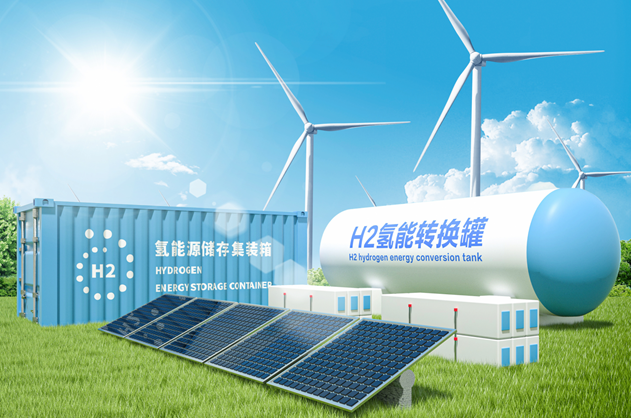
China leads the world in the installed scale of electrolyzers, accounting for about 50%. It has also launched an ALK electrolyzer with a maximum single-tank hydrogen production capacity of 5,000 standard cubic meters per hour and a PEM electrolyzer with a maximum single-tank hydrogen production capacity of 1,000 standard cubic meters per hour. China Energy News reported that China’s complete new energy industrial system has laid a solid foundation for its leading position in the global hydrogen energy industry.
Breakthroughs have been made in gaseous, liquid and solid hydrogen storage and transportation technologies. In gaseous hydrogen storage, 50 MPa pressure long-tube trailers in Europe and the United States have been commercialized, with a single vehicle hydrogen capacity of about 900 kilograms. The global total length of hydrogen pipelines has exceeded 5,000 kilometers, and the maximum hydrogen blending ratio in natural gas pipelines has reached 30%.
In terms of application promotion, the traditional application fields such as refining, synthetic ammonia and methanol have seen steady demand growth, which resonates with the rapid release of demand in emerging application scenarios such as transportation and energy. By December 2025, the global stock of hydrogen fuel cell vehicles had reached about 120,000, and about 1,300 hydrogen refueling stations had been built worldwide.
Zhang Yu, Vice President and Secretary-General of the Hydrogen Energy Branch of the China Industrial Development Promotion Association, said that major countries have distinct development models in the hydrogen energy industry. Wei Suo, Vice President of the China Industrial Development Promotion Association and President of the Hydrogen Energy Branch, noted that China has built a complete industrial chain from hydrogen production and storage to application, and has basically achieved localization of key technologies and equipment.
Wei Suo emphasized that China still has room for improvement in basic materials and core technologies, and the key task is to promote large-scale cost reduction of green hydrogen and expand diversified application scenarios.