AI Integration Reshapes Manufacturing, Paving New Paths for Industrial Workers
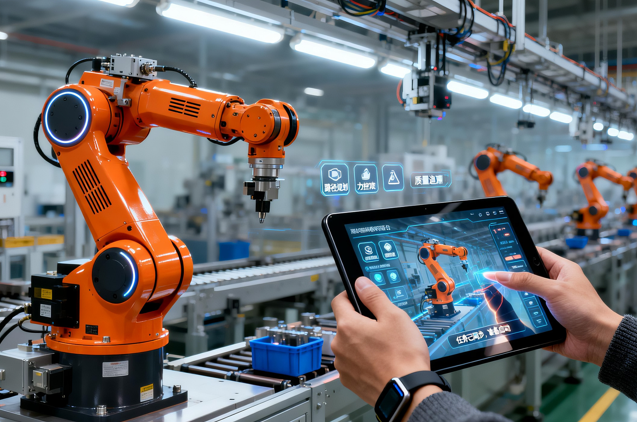
AI vision-guided body welding, sorting robots automatically identifying goods, and robotic arms achieving high-precision welding — artificial intelligence is now deeply integrated into the entire production and manufacturing process. It not only reshapes industrial forms but also rewrites the career trajectories of hundreds of millions of industrial workers. How to reshape the value of industrial workers in the era of human-machine coexistence is not only crucial for personal development but also an important task for industrial upgrading and building a strong manufacturing country.
China Daily reports that industrial workers are experiencing unprecedented transformation pains amid rapid AI advancement. Statistics show that China has built more than 40,000 smart factories cumulatively. The proportion of industrial enterprises applying large models and intelligent agents has risen from 9.6% in 2024 to 47.5% in 2025, indicating the accelerating pace of intelligent manufacturing.
On the one hand, AI significantly improves efficiency, enhances precision and reduces errors, making repetitive, mechanical and low-skilled positions the first to be affected. Assembly line operators, manual inspectors and basic maintenance personnel face the risk of job transfer, but re-employment channels remain narrow, making it difficult for them to switch careers quickly. On the other hand, with the rapid iteration of AI technology, traditional industrial workers have obvious gaps in ability reserves, and "daring not to use, not knowing how to use, and not using well" has become a common dilemma.
These pain points are intertwined, becoming a key hurdle for industrial workers’ transformation and a practical bottleneck restricting the intelligent upgrading of the manufacturing industry. However, while bringing challenges, AI has also opened up new room for the growth of industrial workers. The World Economic Forum reports that by 2030, 92 million jobs worldwide will be replaced by AI, but the technology will also create 170 million new jobs, resulting in a net increase of 78 million employment opportunities.
Robotic operation and maintenance engineers, industrial data annotators, AI trainers and intelligent debugging analysts — these occupations that did not exist a few years ago have now become popular in the recruitment market. The continuous emergence of high-tech positions is accelerating the upgrading of industrial workers’ job structure. More and more traditional workers are adding digital skills to become compound-skilled talents, enjoying wider career paths and greater room for growth.
Li Wei, Director of the China Institute of Industrial Economics, pointed out that the key to breaking the deadlock lies in industrial workers changing their cognition, from passive acceptance to active embrace. "Technological progress is irreversible; future industrial workers will no longer be simple ‘machine operators’," he said. Instead of seeing AI as a "competitor" and fearing being replaced by machines, workers should think about coexisting and cooperating with machines to give play to their own advantages in human-machine collaboration.
Industrial workers’ transformation cannot be achieved alone and requires multi-party collaboration. Enterprises should carry out personalized and targeted AI skill training for workers of different positions and ages, implement gradual "human-machine collaboration" transformation, and convert the "tacit experience" of senior workers into digital assets. The government should also strengthen policy guidance, expand the supply of public resources, and provide more free or low-cost training services for industrial workers from grass-roots, small and medium-sized enterprises and front-line positions. AI is not the end for industrial workers, but a new starting point for transformation and upgrading, injecting lasting momentum into building a strong manufacturing country.