Smart Elevator Upgrade Takes Centre Stage at China’s 17th International Elevator Expo Amid National Urban Renewal Drive
Xinhua News Agency reports the 17th China International Elevator Expo opens in Guangzhou, showcasing cutting-edge AI-powered elevator solutions as China’s domestic elevator sector shifts its core growth driver from newly installed units to after-sales renovation and intelligent upgrading amid nationwide urban regeneration initiatives.
China stands as the world’s largest producer and operator of elevators, with official statistics from the State Administration for Market Regulation confirming the country’s total elevator stock has surpassed 12 million units nationwide. More than 1.1 million of these installations have remained in service for over 15 years, fuelling robust market demand for ageing elevator replacement and additional lift installation within ageing residential compounds across urban regions. Policy frameworks centred on high-quality residential construction, commonly referred to as quality housing development, gained formal policy recognition in the national government work report of 2025, with updated regulatory standards rolled out throughout 2026 to impose stricter requirements on residential safety, eco-friendliness and intelligent property configuration, lifting elevators from basic building fittings to a core yardstick measuring overall housing quality.
Leading industry player Hitachi Elevator (China) rolled out its latest generation intelligent elevator lineup tailor-made for upgraded residential projects during the Guangzhou exhibition. Optimised through refined operational algorithms, these finished models cut average passenger waiting times by 22 per cent during peak operating hours and slash individual unit’s annual power consumption by over 2,500 kilowatt-hours, while built-in intelligent identification modules autonomously flag high-risk scenarios such as electric bicycle carriage into cabins, unattended minors boarding alone and obstruction caused by pet leashes.
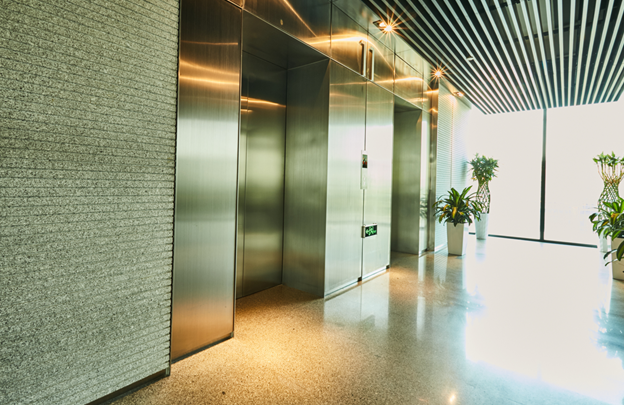
Franz Elevator demonstrated breakthrough safety architecture across its on-site exhibition booth, shifting its operational logic from passive fault response to proactive passenger protection. Its integrated control system leverages millimetre-wave radar detection, automatic child cabin locking, adaptive smart lighting and real-time IoT remote linkage to cope with simulated emergency conditions including passenger cabin confinement, elderly occupant falls, unexpected lift shutdown and unsupervised children entering lift shafts unaccompanied.
Cross-industry integration combining artificial intelligence, industrial robotics and digital building management underpins the full-lifecycle intelligent transformation sweeping China’s domestic elevator sector. Hitachi Elevator sealed a strategic cooperation deal with UBTECH Robotics in May 2026 to deploy Walker S2 industrial humanoid robots along its domestic production lines for automated component assembly and production inspection. The firm’s proprietary cloud operation platform currently links upwards of 450,000 installed elevators nationwide, utilising over 600 bespoke AI diagnostic algorithms to track real-time operational parameters and spot emerging mechanical defects ahead of functional breakdowns.
Loke Elevator partnered with Guangdong Xida Technology to unveil an AI-integrated intelligent elevator ecosystem solution at the same industry event. Built on open digital infrastructure, the technical framework permits seamless access from independent elevator manufacturers, third-party maintenance contractors and residential community service providers, expanding applicable scenarios across diverse property development projects.
Advanced AI-driven active safety architecture is reshaping standardised electronic functional safety specifications for contemporary lift equipment, alongside evolving industrial design that balances practical performance with aesthetic refinement. Intelligent elevator development has gradually broken free from isolated hardware iteration, paving the path for smart high-rise construction to evolve into interconnected, responsive building ecosystems embedded with multi-dimensional perception capabilities.
China’s elevator industry is transitioning steadily from an era focused on universal lift installation to refined upgrades prioritising superior equipment and premium residential development. Ongoing industrial restructuring centres around urban renewal projects, smart municipal governance and low-carbon operational optimisation, steering continuous technological iteration and product refinement across the full industrial chain.