China’s Largest High-Altitude Mountain Wind Farm Expansion Connects First Turbines to Grid
According to China News Service and CGTN reports, the first batch of turbines at the Juliangliang Wind Farm Expansion, China’s wind power project fitted with the country’s largest single-capacity units for highland mountain terrain, achieved successful grid connection on 19 June. The milestone marks fresh progress in the large-scale deployment of high-output wind turbines across cold, high-elevation landscapes.
The development sits in Xundian Hui and Yi Autonomous County under Kunming City, Yunnan Province, with the whole site resting at an average altitude of 3,239 metres above sea level. The 11.1-megawatt turbines brought online in this phase are custom-engineered to cope with the unique environmental constraints of mountainous highland zones. Each unit stands with a 125-metre tower and a 221-metre rotor diameter; the swept area of its blades equals roughly five and a half standard football pitches, delivering robust wind capture efficiency, broad environmental adaptability and advanced intelligent maintenance functionality.
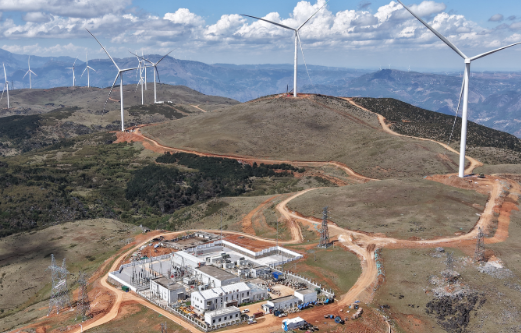
Engineering teams carried out targeted technical refinements to resolve operational challenges endemic to high-altitude locations, including thin atmospheric density and turbulent, erratic wind streams. Optimisations cover core operational algorithms, cabin temperature control hardware and the aerodynamic architecture of rotor blades, which mitigate mechanical risks such as turbine stall and vortex-induced vibration. Planners also tailored unit configurations to account for uneven wind distribution across the site, alongside substation connection capacity and topographical limits. This calibrated layout eliminates efficiency losses caused by grid access bottlenecks and lifts the overall power generation yield of the full complex.
The entire expansion scheme carries a total installed capacity of 158.22 megawatts, paired with a dedicated 220-kilovolt transmission line stretching 40.271 kilometres. The transmission infrastructure creates stable pathways to deliver clean wind power out of the mountainous development zone to regional load centres.
Once construction and commissioning wrap up for the full wind farm, annual on-grid power output is projected to hit 462 million kilowatt-hours. The renewable generation will cut annual consumption of standard coal by 140,000 tonnes and reduce carbon dioxide emissions by 380,000 tonnes, supplying sufficient clean electricity to meet the full-year household demand of 180,000 three-person families. The added wind capacity reshapes the local energy supply mix and accelerates the rollout of low-carbon development frameworks across central Yunnan.
Additional construction work will continue on remaining turbine installation, electrical testing and supporting auxiliary facilities in the months ahead. Operational monitoring systems will run continuous real-time diagnostics across all installed high-capacity units, gathering field data to refine design standards for future high-altitude wind power projects across inland mountainous provinces.