Ice and Snow Resources Ignite "Hot Economy" — Transportation Upgrades and Industrial Innovation Boost Ice and Snow Tourism
This snow season, Wanfeng Tonghua Ski Resort, located in the southeast of Jilin Province, has welcomed numerous skiing enthusiasts, who put on snow gear and snowboards to ski down high mountains and enjoy the fun of skiing to the fullest.
The predecessor of Wanfeng Tonghua Ski Resort was Jinchang Ski Resort, the first alpine ski resort in New China. In December 2021, the upgraded and expanded Wanfeng Tonghua Ski Resort opened to the public on its original site. However, in the previous snow seasons, due to the lack of high-speed rail stops in Tonghua, tourists from other provinces had to drive a long distance to ski here. With the official opening of the Shenyang-Baishan High-Speed Railway on September 28, 2025, tourists have more options to enjoy ice and snow activities here.
In recent two years, ice and snow tourism in Northeast China has become increasingly popular. Shenyang, Tonghua, Changbai Mountain and other places with abundant ice and snow resources are deeply favored by tourists. However, restricted by time, space, transportation and other factors, they once existed as scattered ice and snow resources, developing independently. The opening of the Shenyang-Baishan High-Speed Railway has shortened the travel time for tourists, enabling regional cooperation and boosting the continuous boom of ice and snow tourism.
In Shenyang, Liaoning Province, hot spring resorts have launched a number of popular projects, integrating ice and snow with hot springs to bring tourists a unique "cold-hot collision" experience. At the foot of Changbai Mountain, the giant snow sculpture "Yunding Heavenly Palace" has made a new appearance, with stunning ice and snow light shows staged one after another; on the basis of upgrading ski trails, Wanfeng Tonghua Ski Resort has launched a pet park and a snow amusement park to meet the needs of tourists of different ages.
At the same time, the existing Changchun-Hunchun High-Speed Railway has increased the number of trains, further shortening the travel time between Changchun and Jilin City. In terms of civil aviation, Jilin Province has added 5 direct routes including Changchun-Haikou and Changbai Mountain-Changzhou, and increased flights to 16 key source cities such as Guangzhou and Qingdao, building an "ice and snow air corridor" connecting the north and the south and providing more travel options for tourists.
From skiing on Tonghua's powder snow, soaking in Shenyang's hot springs, appreciating Changchun's ice lanterns to viewing Jilin's rime, the integration of scattered ice and snow resources is supported by the full connection of transportation and market factors. According to big data from UnionPay Merchant Services, during this year's New Year's Day holiday, Jilin Province received 8.11 million domestic tourists with a total tourism expenditure of 9.1 billion yuan; data from Liaoning Provincial Department of Culture and Tourism shows that the number of tourists and total tourism revenue in Liaoning Province during the holiday increased by 19.72% and 20.64% respectively on a comparable basis.
Starting from 00:00 on January 26, the national railway implemented a new train operation plan. This adjustment focuses on increasing transportation capacity from Changbai Mountain to Beijing and Shenyang, and adjusts some trains from Changchun to Beijing Chaoyang and Changchun to Qingdao North to start and end at Changbai Mountain, further expanding the high-speed rail lines connecting scenic spots in Northeast China to major cities across the country.
In winter, Xinjiang is covered with snow, presenting a silver-white scenery. At Sayram Lake Ski Resort, the newly upgraded 15,000-square-meter ski equipment hall provides tourists with one-stop services including ticket purchase, equipment rental and catering.
Since its opening in October 2025, Sayram Lake Ski Resort has received 17,000 tourists, with a daily average of more than 300. Since the "14th Five-Year Plan", Xinjiang has successively issued policy documents such as the "Plan for the High-Quality Development of Ice and Snow Economy in Xinjiang" and the "Measures for Bank Loan Interest Subsidies for Ski Resorts above Grade S in the Xinjiang Uygur Autonomous Region", providing all-round support for the ice and snow industry in terms of land supply, financial support and talent training.
Today, major ski resorts in Xinjiang are no longer single skiing venues, but comprehensive resort destinations integrating sports, sightseeing, culture and leisure. At Altay General Mountain International Ski Resort, paragliders glide over the ski trails and hot air balloons float slowly above the resort, forming a beautiful scene with the continuous snow-capped mountains.
The innovation of formats is supported by strong accommodation facilities. Statistics show that Altay City currently has 177 normally operating hotels and homestays, providing 8,151 guest rooms. The vigorous development of the ice and snow industry has not only ignited tourists' enthusiasm, but also strengthened the confidence of practitioners.
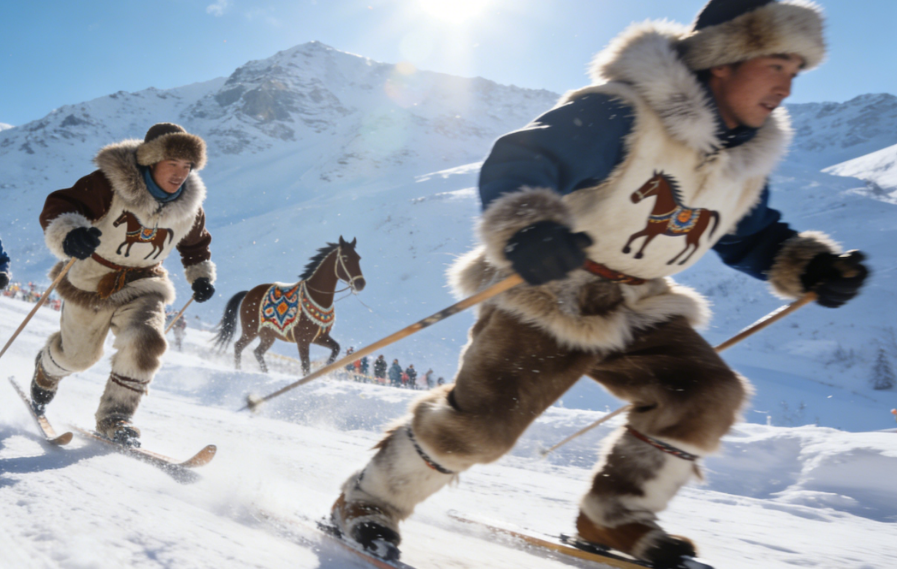
In January this year, an ancient fur skiing competition was held at Altay General Mountain International Ski Resort, where contestants competed fiercely on fur snowboards with solid wood ski poles. Historically, fur snowboards were important means of transportation for local herdsmen in winter; now their function has shifted from hunting and travel to sports, becoming a characteristic project enriching winter ice and snow tourism content.
Qinggeli Wolf Mountain International Ski Resort in Qinghe County, Altay Prefecture, launched 20 cultural and creative products this year, which integrate local cultural characteristics and have both commemorative and practical value. Today, Xinjiang's ice and snow economy has formed a differentiated development pattern between northern and southern Xinjiang: northern Xinjiang focuses on high-quality ice and snow sports and international events to create professional experience scenarios, while southern Xinjiang launches differentiated ice and snow products integrating folk customs and characteristic leisure based on regional characteristics.
This winter, with the successive launch of ice and snow activities across Xinjiang, more and more tourists have stepped into the ice and snow world. The ice and snow economy continues to release strong "hot momentum", vividly depicting the development prospect that "ice and snow are also gold and silver mountains".