"Chinese-Core" Flowers Shine in Spring Festival, Driven by Technology and Culture for High-Quality Industry Development
During the just-concluded Lunar New Year, China’s flower market witnessed booming supply and demand. The latest monitoring by the China Flower Association shows that this year’s Spring Festival flower consumption featured distinct diversification and personalization. Amid the upsurge of this "beautiful economy", besides traditional mainstream varieties such as phalaenopsis and cymbidium, a batch of "Chinese-core" flowers independently cultivated by domestic breeders, integrating regional characteristics and cultural genes, made a stunning appearance. Red as flames or pink as dawn, they became a bright sight in the Spring Festival and outlined a vivid picture of the high-quality development of China’s flower industry, demonstrating its strong vitality and innovation.
As a typical representative of independent innovation in high-end bulb flowers, domestic amaryllis has achieved a leap from import dependence to independent control. For a long time, China’s high-end bulb flowers such as amaryllis and tulips have been highly dependent on imports, with single varieties, poor adaptability and high prices, which once restricted industrial development and consumption upgrading. During this year’s Spring Festival, new domestic amaryllis varieties cultivated by a Guangdong enterprise were popular at the Beijing Flower Trading Center. With flower shape and color similar to peonies, large and bright flowers, as well as the auspicious meaning of "destined to be prosperous" and strong ornamental value, they attracted many consumers to stop and purchase.
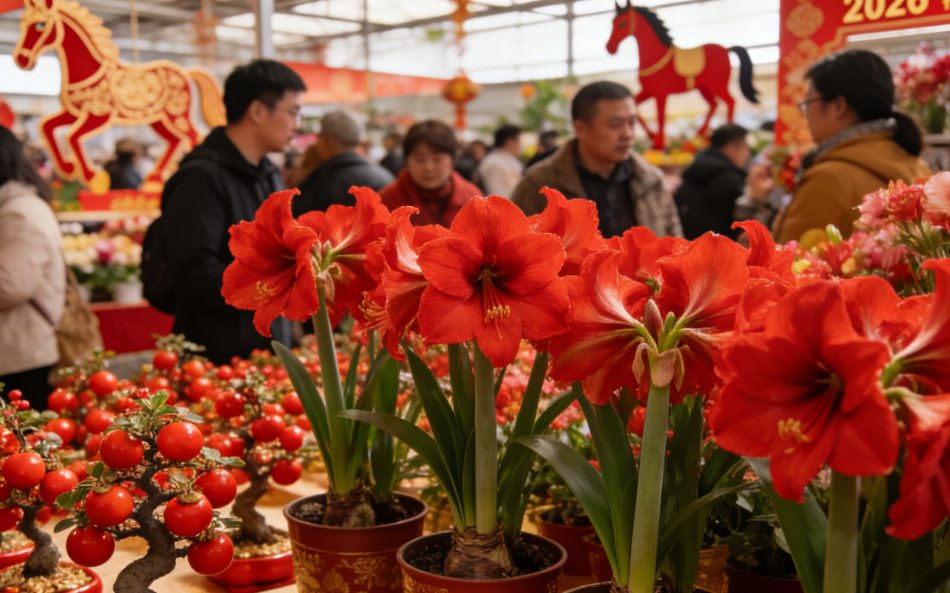
The market popularity of domestic amaryllis is supported by the enterprise’s more than 20 years of technological dedication and perseverance. The amaryllis cultivated by the enterprise has achieved precise flowering period control; through technological breakthroughs, it blooms on time at key nodes such as the Spring Festival and can flower multiple times a year, with some varieties having a natural fragrance. This forms differentiated competition with imported amaryllis, which only flowers once a year and has no fragrance, better fitting the aesthetic and cultural needs of domestic consumers. It is reported that amaryllis takes 3 to 4 years from cross-breeding to stable traits, and another 6 to 7 years from mass-producing bulbs to market launch, so a new variety often takes up to 13 years to develop. At present, domestic amaryllis has made breakthroughs in variety innovation and is 10 to 20 yuan cheaper than similar imported varieties, providing consumers with more cost-effective choices.
Now, the enterprise has built a full industrial chain system from breeding and tissue culture to market promotion. Relying on an integrated online-offline sales network, its amaryllis is not only popular in the domestic market but also exported to Southeast Asia, truly realizing the leap from "introducing in" to "going out" in flower cultivation. To solve the pain point of winter transportation in northern China, the enterprise has also set up a cultivation base in the Beijing Daxing Flower Industrial Park to achieve localized planting. This year, the sales volume of New Year flowers in the northern market alone reached several million yuan, further expanding the market coverage of domestic flowers.
If domestic amaryllis is a microcosm of independent innovation in bulb flower seed industry, the lucky fruit bonsai cultivated by an enterprise in Kunshan, Suzhou, has injected new vitality into the ornamental flower industry through the integration mode of "technology + culture". The enterprise pioneered the combination of lucky fruit with Su-style bonsai techniques, creating a new type of bonsai art integrating flower viewing, fruit appreciation and leaf tasting, enriching bonsai categories and cultivating innovative varieties with unique local characteristics.
Lucky fruit is bred and improved from traditional spiny Ilex cornuta. Its fruits are bright red and round, with various leaf shapes, including standard oval and unique pentagonal or octagonal shapes. It is called the "wisdom tree" because it retains thorns at the bottom of the crown to prevent damage and evolves thornless leaves at the top to facilitate birds’ feeding and seed dispersal. In bonsai creation, the breeding team broke the traditional rule of Su-style bonsai of "six platforms, three supports and one top", integrated various shaping techniques of Southern School and Shanghai School, abandoned rigid template-based creation, respected the natural growth form of plants, and shaped each bonsai according to its characteristics through aluminum wire winding and precise pruning, making each bonsai unique.
After years of accumulating original germplasm materials, the breeding team has long carried out artificial selection and improvement. Aiming at the limited climate adaptability of Aquifoliaceae plants, it has selected and cultivated lucky fruit varieties with moderate leaves and plump fruits. Destructive tests have proved that this variety can withstand a low temperature of -18℃ and a high temperature of 42℃, breaking the climate adaptation limit of traditional Aquifoliaceae plants and the regional consumption limitation of "Southern fine trees not growing north of the Yangtze River". Meanwhile, the enterprise has created products of different specifications according to market demand: large bonsai are suitable for enterprise environmental greening, while small bonsai are suitable for holiday gifts or home decoration, allowing traditional bonsai art to truly enter ordinary families and meet the aesthetic and usage needs of different consumer groups.
From the independent breeding and precise flowering control of domestic amaryllis to the germplasm improvement and technological innovation of lucky fruit bonsai, the transformation of China’s flower industry is driven by the continuous empowerment of science and technology and the in-depth excavation and innovative expression of local cultural connotations. Today, flower consumption has shifted from the ritual demand of traditional festivals to the daily and personalized "self-pleasing" consumption. Domestic flowers with auspicious meanings, both beauty and connotation, have accurately captured consumers’ yearning for a better life and promoted the popularization and normalization of flower consumption.
Relevant industry reports show that by the end of 2025, the market scale of China’s flower industry had reached 100 billion yuan, ranking as the world’s largest flower producer. At present, China’s flower industry is gradually breaking the bottleneck of seed source dependence, and under the dual drive of technology and culture, it is building an independent and controllable industrial system. From cutting-edge breeding technology research, localized germplasm resource cultivation to the innovation of "flower + culture" product forms, it is promoting industrial transformation and upgrading in an all-round way. This industrial transformation centered on "Chinese-core" is driving China’s flower industry to leap from "large scale" to "strong quality".
In the future, with the popularization of intelligent planting facilities, the formation of flower advantageous production area clusters, and the continuous emergence of new formats such as "flower +", China’s flower industry will continue to focus on technological innovation and cultural integration, cultivate more "Chinese-core" flower varieties with local characteristics and market competitiveness. While meeting the people’s demand for a better life, it will draw a new chapter of high-quality development where "beautiful economy" and cultural inheritance coexist harmoniously.