Dragon Boat Races Unite Heritage, Eco-restoration and Rural Revitalisation Across China Ahead of Dragon Boat Festival
According to Xinhua News Agency, the resonant beat of dragon boat drums echoes along waterways stretching across every region of China as the Dragon Boat Festival draws near. Events hosted in water towns from ancient rivers in Dongguan, Guangdong, to the banks of the Xiao River in Daoxian, Hunan, integrate intangible cultural heritage inheritance, river ecological remediation, cultural tourism integration and rural revitalisation as core elements of local celebration schemes. Dragon boat racing has evolved beyond a competitive aquatic sport to become a vital thread that anchors local collective memory, showcases cultural confidence and fuels regional socioeconomic advancement.
Dongguan: Centuries-old Waterway Revives Dragon Boat Traditions Following River Ecological Renewal
The First Dongguan City Dragon Boat Invitational Tournament opened along Shanzhou River in Guancheng Subdistrict, Dongguan City on 13 June, reviving dragon boat customs once widespread along the ancient water channels of the locality. The event marks another project that leverages intangible cultural heritage to revitalise historic cultural blocks, following the launch of heritage exhibition spaces within the Dongguan Memory cultural precinct run by the municipal centre for intangible cultural heritage protection.
The tournament sets separate categories for junior and adult competitors. Eighteen student dragon boat teams from Guancheng Subdistrict, Wangniudun Town and Shipai Town take part in junior races, alongside multiple adult squads formed by merchants based in Dongguan Memory Block, public institutions, educational establishments, banking outlets and medical facilities. The junior 8-person 200-metre sprint race staged in the morning draws particular attention, with young rowers straining in unison to showcase youthful vigour and team spirit.
Junior competitions are structured across preliminary heats, repechage rounds and knockout stages. During heats, the 18 youth teams compete head-to-head over straight 200-metre courses. Thunderous drumbeats carry across the water as dragon boats surge forward, while crowds lining both riverbanks cheer loudly, with sustained applause greeting every crew crossing the finishing line.
The river venue carries a thousand years of local cultural lineage. Participation lets young people absorb the depth of living heritage while grasping the value of collaborative effort forged through coordinated rowing and shared competition.
The large-scale race also delivers tangible demonstration of comprehensive environmental improvements completed along Shanzhou River. Long regarded as the mother waterway of Guancheng, the river hosted bustling waterborne trade, busy docks and thriving commerce for hundreds of years, recording the city’s development from Tang and Song urban construction to flourishing Ming and Qing trade and the street culture of the Republican era. Generations of residents built their lives alongside its waters, yet the waterway lost vitality from the 1990s amid rapid urban expansion and population growth.
Comprehensive renewal works broke ground in 2023 alongside the wider Dongguan Memory regeneration project, covering sewage interception, sediment dredging, ecological restoration and landscape upgrading. The river channel now flows unobstructed with steadily improved water quality, lined with lush greenery and neatly paved waterside walkways open to all residents.
Clean water and widened river corridors create ideal conditions for hosting competitive dragon boat fixtures. The waterway now serves multiple community purposes: a leisure destination for evening strolls, a regular training ground for dragon boat crews refining race tactics and a practical illustration of green development frameworks guiding high-quality urban growth in Guancheng.
Daoxian: Hundreds of Dragon Boats Race Along Xiao River in China’s Renowned Dragon Boat Town
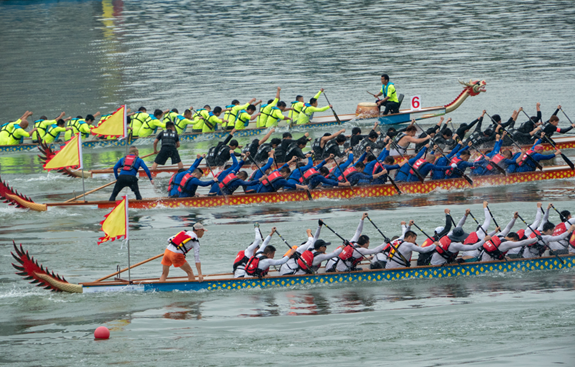
Parallel large-scale dragon boat programmes unfold along the Xiao River in Daoxian, Yongzhou, Hunan Province. Three consecutive major competitions have run since 11 June: the China Dragon Boat Open, Hunan Provincial Super League Qualifiers and the nationally inscribed intangible cultural heritage Daizhou Dragon Boat Race, creating a spectacular scene of hundreds of vessels racing side by side amid constant drum rolls and spectator cheers.
Traditional Daizhou dragon boats feature distinctive upturned bows and sterns, crafted through over one hundred days of meticulous, multi-stage handiwork governed by rigorous production standards. The racing custom stretches back more than a millennium, forming a core element of local folk culture cherished by all residents. Daoxian earned the official title of China’s Dragon Boat Town from Hunan Provincial Government in 2002; the Daizhou dragon boat race was listed as provincial intangible cultural heritage in 2006, before gaining national-level intangible cultural heritage status in 2021.
Running from 15 to 17 June, the nationally recognised heritage race forms the centrepiece of the event series, centred on traditional 500-metre straight sprint contests. The competition assembles 185 teams with over 6,000 local athletes drawn from more than ten towns and subdistricts across Daoxian, plus invited cross-regional crews from Jiangsu and Hubei provinces to compete on equal footing.
A full suite of integrated cultural, sporting and commercial activities runs alongside the races, including dragon boat craft workshops, traditional Daizhou river banquets, rural produce markets and streets showcasing local herbal medicine. All scenic spots within the county waive entry fees, guided tour charges and car parking tariffs throughout the event period, with special consumer discounts and shared accommodation initiatives rolled out to stimulate on-site consumption and drive economic activity via cultural gatherings.
Daizhou dragon boat customs have continued to evolve within rural communities in recent years. Master craftspeople have developed the folk craft into a scaled characteristic industry, building a replicable model for industrialising traditional culture grounded in authentic craft standards, structured operational management and integrated cultural tourism. The framework acts as a working template for leveraging regional cultural assets to advance rural revitalisation and sustained high-quality county-level economic growth.
The schemes delivered in both locations illustrate how millennium-old folk traditions can remain vibrant and continuously passed down only when fully embedded within contemporary daily life and aligned with local developmental priorities. The age-old custom of dragon boat racing keeps writing fresh chapters of cultural inheritance and innovative development across modern China.