China Advances Seed Industry Revitalization in Critical Year of 14th Five-Year Plan
2026 marks the first year of the 14th Five-Year Plan and a crucial period for China’s seed industry revitalization campaign to move from “achieving results in five years” to “making major breakthroughs in ten years”. Recently, at the 2026 Seed Conference and Nanfan Silicon Valley Forum held in Sanya, Hainan, experts gathered to discuss key issues including the criteria for high-quality seeds, activation of germplasm resources potential and improvement of the commercial breeding system.
Demand-driven innovation is accelerating the breeding and promotion of breakthrough varieties. At the field display session of the forum, more than 1,600 new crop varieties from 156 breeding research institutions and enterprises across the country were exhibited, showcasing the fruit of China’s seed industry development.
Zhao Jiuran, chief corn scientist at the Beijing Academy of Agriculture and Forestry Sciences, summarized the standards for high-quality corn varieties as “easy to plant, easy to sell and delicious”. “Easy to plant means strong disease resistance, stress tolerance, wide adaptability and excellent yield; easy to sell requires good appearance and long shelf life; delicious emphasizes excellent taste and unique nutritional quality,” he explained.
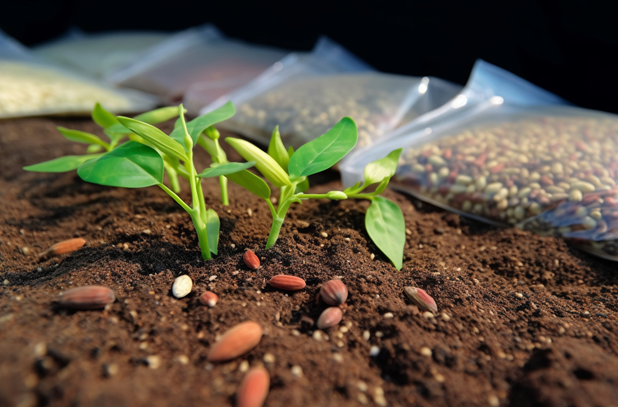
Li Xinhai, director of the Department of Science and Technology Management at the Chinese Academy of Agricultural Sciences, noted that over the past decade, especially since the launch of the seed industry revitalization campaign, China has cultivated a number of varieties urgently needed for production. Currently, high-quality varieties account for 90% of approved varieties, with breeding shifting from pursuing high yield alone to focusing on group yield and from quantitative growth to qualitative improvement.
Zhang Hongyu, president of the China Agricultural Risk Management Research Association, emphasized the need to link with the “big market” and drive variety innovation through demand. “We should develop new varieties of major agricultural products and competitive ones from the perspectives of ensuring security, development, demand and trade,” he said.
China’s germplasm resources, the foundation of breeding innovation, rank first in the world in total long-term preservation, thanks to the third national crop germplasm resources survey. Chen Yanqing, a researcher at the Institute of Crop Science, Chinese Academy of Agricultural Sciences, said the national crop germplasm resource sharing information platform, launched in 2025, is promoting the safe protection, sharing and efficient utilization of resources.
Biological breeding industrialization has entered a critical stage of accelerated expansion. Relevant person in charge of the Department of Science and Technology of the Ministry of Agriculture and Rural Affairs stated that the ministry will support key technological research, accelerating gene mining and new product iteration. Li Jiayang, academician of the Chinese Academy of Sciences and director of the Yazhou Bay National Laboratory, noted that the next decade will usher in the era of “intelligent breeding”.
Enterprise-university-research collaboration is activating the engine of seed variety transformation. Zhang Xiaoqiang, general manager assistant of China National Seed Group Co., Ltd., said the company is relying on Syngenta Group’s global R&D resources to accelerate the creation and industrial application of new germplasm. It has implemented 33 “call for proposals” projects, applied for 25 patents and approved 11 field crop varieties.
Henan Yuyu Seed Industry Co., Ltd. has seen its sales jump from 130 million yuan in 2020 to 1.2 billion yuan in 2025. Yang Xueli, its deputy general manager, said the company adheres to “promoting one generation, reserving one generation and researching one generation” to ensure high-quality varieties are available at all times.
The 2026 Seed Conference and Nanfan Silicon Valley Forum provided the venue and core discussion content for this report. With joint efforts from the government, enterprises, universities and research institutions, China is steadily advancing the high-quality development of its seed industry, laying a solid foundation for food security and agricultural modernization.