Water Diversion Project in Anhui Boosts Water Supply, Shipping and Ecological Gains
According to CNR News, the Yangtze-Huaihe Water Diversion Project, a strategic national water infrastructure, delivers multi-dimensional operational benefits across water supply, inland shipping and ecological restoration. The provincial state-owned operator continues to advance construction and refined operational management to underpin revitalisation in northern Anhui.
Phase two construction maintains accelerated progress amid fixed annual investment targets. By the end of May 2026, 40.54% of the yearly 3.5 billion yuan investment quota had been completed, while cumulative overall project investment reached 77.78% of the total budget. Official figures show the total investment of phase two stands at 22.701 billion yuan. Two dedicated water supply routes covering Fuyang and Xiaoxian-Dangshan have achieved full connectivity. The residential water diversion sub-project of phase two officially went into operation in late December 2025, supplying stable cross-basin water resources for 30 million residents across northern Anhui.
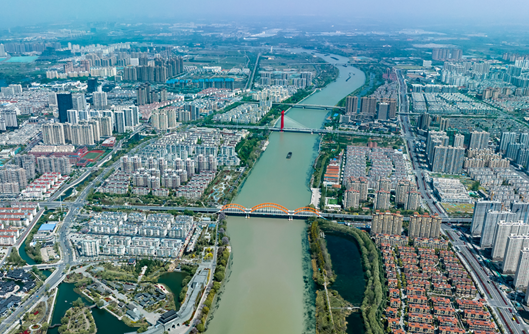
Water supply capacity has seen steady practical output. On 3 May 2026, cumulative water delivery from the Fuyang pressurised pumping station to urban and rural areas of Fuyang surpassed 100 million cubic metres. In the summer of 2025, northern Anhui suffered its most severe drought since 1950. Dual water intake routes were activated to divert 650 million cubic metres of water from the Yangtze River to the Huaihe River basin, mitigating widespread water shortages for industrial, agricultural and domestic use. Since emergency water supply started for Bozhou urban districts in June 2020, the project has transferred 2.456 billion cubic metres of water to water-deficient zones in northern Anhui and adjacent regions. Long-term operational plans indicate annual water diversion capacity will rise to 3.3 billion cubic metres by 2035.
Inland shipping momentum keeps expanding following the full navigation of the Jianghuai Canal. Vessels travelling between northern Anhui and upstream Huaihe tributaries can cut sailing distances to the Yangtze mainstream by 200 to 600 kilometres, lowering logistics expenditure for bulk minerals, grain and building materials. In 2025, the canal recorded 30,364 vessel passages, marking a 6.39% year-on-year increase. Over half of the 5,000 registered vessels using the waterway originate from northern Anhui and Henan provinces, reflecting growing cross-regional inland freight demand.
Measurable ecological improvements have been documented across river basins. Continuous water replenishment has reversed falling groundwater levels in water-scarce northern Anhui. Groundwater tables in Fuyang and Bozhou have climbed by 5.84 metres and 1.12 metres respectively over the past three years. The operator has upgraded regional water quality supervision networks by adding automatic online monitoring stations along key water conveyance corridors including the West Lixi River and extended Huaihe-Northern Anhui water diversion routes. Routine inspections on sewage discharge outlets and scattered pollution sources are conducted on a rolling basis to sustain unified water quality standards for diverted cross-basin water.
Subsequent construction will focus on finishing supporting pumping stations and intake facilities. All phase-two trunk water conveyance lines are scheduled for full completion by 2028, forming an interconnected regional water grid covering emergency water regulation, daily residential supply and ecological water replenishment.